
“The practice of parkour centres around the use of the individual’s environment…It involves using your body to navigate the world around you, with movements like jumping, swinging, climbing, rolling, and vaulting.
Whilst you might have seen some amazing athletes doing incredible things on social media, parkour can be a brilliant way to start moving if you have never been active before, as part of a very welcoming, inclusive community.” – ParkourUK
The art of doing acrobatic movement in your own style is an approach championed by the new generation of largely self-taught athletes, who largely learn from YouTube and social media. Everyone needs a helping hand along the way though, and this is where training in a safe space with qualified coaches can help with achieving your goals. Springfit are delighted to offer this environment for parkour enthusiasts!
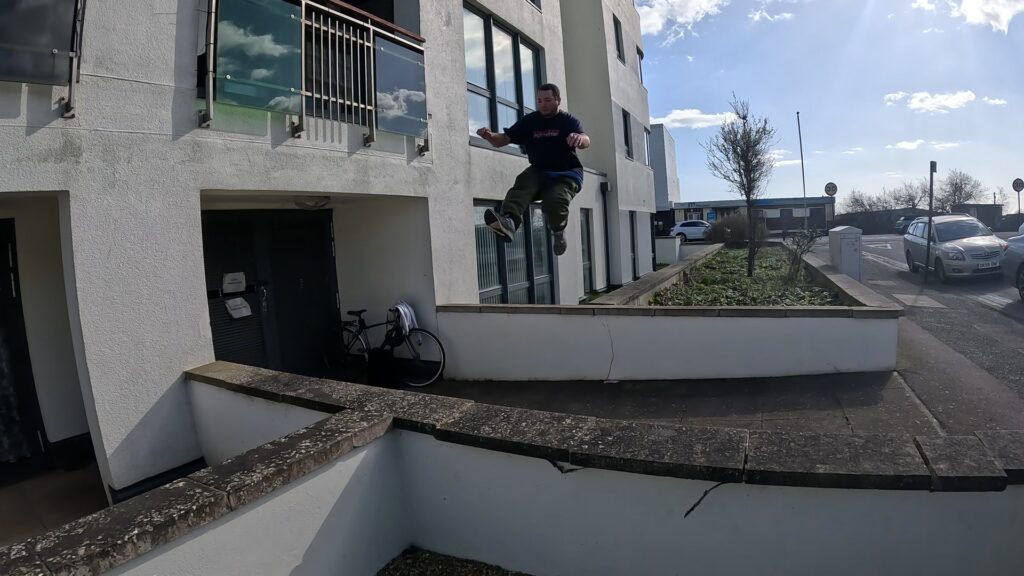
Defining Parkour
Parkour is largely defined as the physical discipline or sport of training to overcome movement based challenges or obstacles using minimal additional equipment, except perhaps for a good pair of shoes!
As a younger sport there is some variation within the definitions, you may come across some of the following:
- efficient A to B movement used to escape or to reach
- free-running: the art of including acrobatic, aesthetic movements and styles within any given environment as a form of expression
- “Être fort pour être utile” – to be strong to be useful and the training that comes along with it! An older method of early Parkour training born from Georges Hebért and Method Naturelle
- Parkour as a philosophy – overcoming challenge or obstacles within one’s path by adapting one’s movements to the environment. It is also a state of mind, rather than simply a set of actions, which encourages practitioners, known as ‘traceur’ and ‘traceuse’s, to overcome and adapt to everyday mental and emotional obstacles as well as enjoying the challenge of conquering physical barriers.
Regardless of our Members personal definitions you can expect to see them running, jumping, vaulting, climbing, balancing, and somersaulting over, on to, through, and between our equipment.
Our Parkour training at Springfit focuses on safety, longevity, personal responsibility, and self-improvement. It discourages reckless behavior, showing off, and dangerous stunts. Parkour practitioners value community, humility, positive collaboration, sharing of knowledge, and the importance of play in human life, while demonstrating respect for all people, places, and spaces.
Why is it Important?
- the opportunity to train to be fitter, healthier and more in tune with your own body.
- it offers the ability to overcome your fears and to think about the world in a different way.
- its accessible and can be practiced by nearly anyone of any level, at an individual level it requires no specialised equipment
- historically there was a focus on non-competition and even now that competitions are emerging within the sport it remains a haven for those that wish to practice at their own pace without the pressure to perform in front of or compare themselves to others.
- the broader Parkour community is typically welcoming and accepting, providing amply opportunity for socialising and making friends
- practicing challenge builds adaptability and resilience
Parkour's History
| Approximate Date(s) | Event(s) |
|---|---|
|
1925 – 1935 |
Georges Herbert and Method Naturelle considered by many to be some of the earliest building blocks of Parkour. |
|
1984 – 1987 |
David Belle and the Yamakasi begin training in Lisses and Evry in France |
|
1997 |
David Belle releases his “Speed Air Man” video (fun fact – sounds like spiderman if you say it fast!) which leads to a growing online popularity of Parkour.
Also the year in which Parkour was first televised as “l’art du deplacement” by the Yamakasi |
|
2003 – 2005 |
Jump London and Jump Britain documentaries are aired in the UK, acting as a catalyst for the UK Parkour scene |
|
2008 – 2011 |
Youtube and online forums drive Parkour’s community growth in the UK and worldwide. Teams and companies like Trace and Storm emerge.
Early experiments with competition and more regulated approaches begin with events like Redbull’s Art of Motion and Barclaycard World Freerun Championships. Bewbush Crawley and Newhaven Brighton build some of the first UK outdoor Parkour parks. |
|
2016 |
Parkour UK is established as the National Governing Body for UK, helping fully establish Parkour as its own Sport, distinct and separate from other acrobatic sports and disciplines. |
|
Recent and Present Day |
Parkour continues to grow in awareness and popularity with recognised Coaching pathways leading to more accessible classes, more competitive options such as Sports Parkour League, local Takeovers and British Parkour Championships and indoor purpose built gyms arrive. Parkour also keeps to its varied and experimental roots with off-shoots such as ChaseTag and Gizmo Style Battles taking inspiration from and developing traditional Parkour influence. |
What Now?
There has never been a better time to get involved with Parkour, with a requirement for consistent, disciplined training with an emphasis on functional strength, physical conditioning, balance, creativity, fluidity, control, precision, spatial awareness, and looking beyond the traditional use of objects, the gymnasium is the perfect place to train.
No matter your age, ability or experience check out our Parkour page for the types of classes we offer!